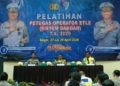


Checkpapuanow.com – Minister of Cooperatives Budi Arie Setiadi has officially handed over the legal status certificates (SK) for Village and Subdistrict Cooperatives (Kopdes/Kel) in Nabire, Central Papua, on Tuesday, August 12, 2025. The minister described the handover as a crucial and strategic starting point for the program’s next phase.
Following the issuance of the certificates, the central and regional governments will jointly provide guidance, deliver training programs, open access to capital, and facilitate partnerships. These efforts aim to strengthen the operational capacity of the newly established cooperatives and maximize their contribution to local communities.
Budi Arie encouraged the people of Central Papua to develop robust and independent cooperatives. He stressed the importance of harnessing local resources, creating tangible benefits for residents, and fostering a shared sense of pride.
“Through the Kopdes/Kel Merah Putih initiative, farmers will be able to process their harvests more effectively. Fishermen can expand the market for their catches, and artisans will have opportunities to sell their crafts at fair prices,” the minister said in his statement.
He emphasized that the success of the program depends on the full support of traditional leaders, religious figures, and the broader public. With strong community participation, he expressed confidence that Kopdes Merah Putih in Central Papua would grow into a sustainable economic institution.
Budi Arie also voiced his hope that Nabire could serve as a model for other regions in implementing the initiative successfully. “Let us demonstrate that when the people, the government, and traditional leaders work hand in hand, village self-reliance is not just a dream—it can become a reality,” he remarked.
According to the minister, all 1,200 villages and subdistricts in Central Papua, including 81 in Nabire, have already formed Kopdes Merah Putih units. The establishments were decided through special village deliberations, ensuring that each cooperative reflects the needs and aspirations of the local population.
The Kopdes/Kel Merah Putih program is designed to empower rural economies by providing organizational legitimacy, enhancing market access, and ensuring fair trade practices for local producers. By formalizing these cooperatives, the government aims to create a sustainable framework for economic growth in remote and rural areas.
In addition to economic benefits, the initiative seeks to strengthen community bonds. By involving local leaders and encouraging collective decision-making, the program promotes social cohesion alongside financial resilience.
The Nabire event marks the beginning of a long-term commitment by both the central and local governments to nurture cooperative-based development in Central Papua. Officials expect the next steps—training, capital access, and business partnerships—to accelerate the region’s economic progress and inspire similar actions in other provinces.
As the program Village Cooperatives moves forward, stakeholders will monitor its implementation to ensure transparency, accountability, and measurable impact. The government remains optimistic that the initiative will not only boost the local economy but also set a precedent for inclusive development across Indonesia.