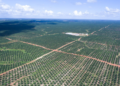


Checkpapuanow.com – The Governor of Papua, Mathius D. Fakhiri, has reaffirmed the Provincial Government’s commitment to environmental protection by stating that no new permits will be issued for the opening of palm oil plantations in Papua. This policy applies especially to plantation projects that carry a high risk of damaging soil structure and disrupting the ecological balance in the region, widely known as the Land of the Birds of Paradise.
Speaking in Jayapura on Thursday (January 1, 2026), Governor Fakhiri emphasized that his statement should not be misunderstood or misrepresented. He clarified that the provincial policy is a direct follow-up to guidance delivered by President Prabowo Subianto to governors and regents across Indonesia. According to him, the president’s message did not encourage the creation of new palm oil estates, but rather focused on regulating land use more responsibly.
Fakhiri explained that the central government’s direction highlights the importance of land function conversion and optimization, instead of large-scale expansion of plantations. Therefore, Papua’s provincial administration has chosen to take a cautious and environmentally conscious approach. This approach aligns with long-term sustainability goals and reflects growing concerns about deforestation, soil degradation, and biodiversity loss.
Furthermore, the governor stressed that the current policy priority lies in restructuring existing palm oil plantations that already hold permits. In practice, this means that the provincial government will closely review companies operating in the sector, particularly those that have failed to fulfill their legal and administrative obligations. Companies that do not comply with regulations will face strict consequences.
According to Fakhiri, several palm oil companies have already been evaluated, and decisive action has been taken. By 2025, the provincial government had revoked a number of plantation permits after discovering that companies failed to meet their mandatory obligations, including financial and operational requirements. He confirmed that he had instructed relevant regional agencies to continue this process and ensure enforcement without delay.
The evaluation process, he added, will be conducted comprehensively. Authorities will assess whether companies are actively operating, adhering to environmental standards, and contributing to local development. If violations are identified, business permits will be withdrawn. This measure is intended to create accountability while preventing speculative land control that offers no real benefit to the region.
Importantly, Fakhiri underlined that land previously used for palm oil plantations, once the permits are revoked, will not be reassigned for new palm oil development. Instead, the provincial government plans to redirect these areas toward alternative commodities that are considered more environmentally friendly. One of the main alternatives being promoted is cocoa cultivation, in line with programs initiated by the Ministry of Agriculture.
The governor revealed that Papua has received cocoa seedlings as part of agricultural support from the central government. These seedlings will be used to rejuvenate long-neglected plantation lands, including former state-owned plantation areas that have remained idle for years. This strategy aims to improve land productivity without exposing the soil to the intensive practices commonly associated with palm oil cultivation.
In addition to restricting permits, the provincial government has introduced new requirements for palm oil companies that continue to operate legally in Papua. One of the key obligations is the construction of palm oil processing facilities within the province. Fakhiri explained that this policy is designed to increase local value-added activities and reduce the practice of shipping crude palm oil (CPO) to other regions for processing.
By requiring companies to build processing plants locally, the government expects to create more employment opportunities for Papuans. This measure also aims to strengthen the regional economy by ensuring that more stages of the palm oil value chain take place within Papua itself. As a result, communities surrounding plantation areas are expected to gain greater economic benefits.
Governor Fakhiri concluded by reiterating that environmental protection and community welfare are central to Papua’s development agenda. While the province remains open to investment, it will not compromise its natural resources and ecological integrity. Through stricter regulation, permit evaluation, and a shift toward sustainable commodities, the Papua Provincial Government seeks to balance economic growth with long-term environmental responsibility.